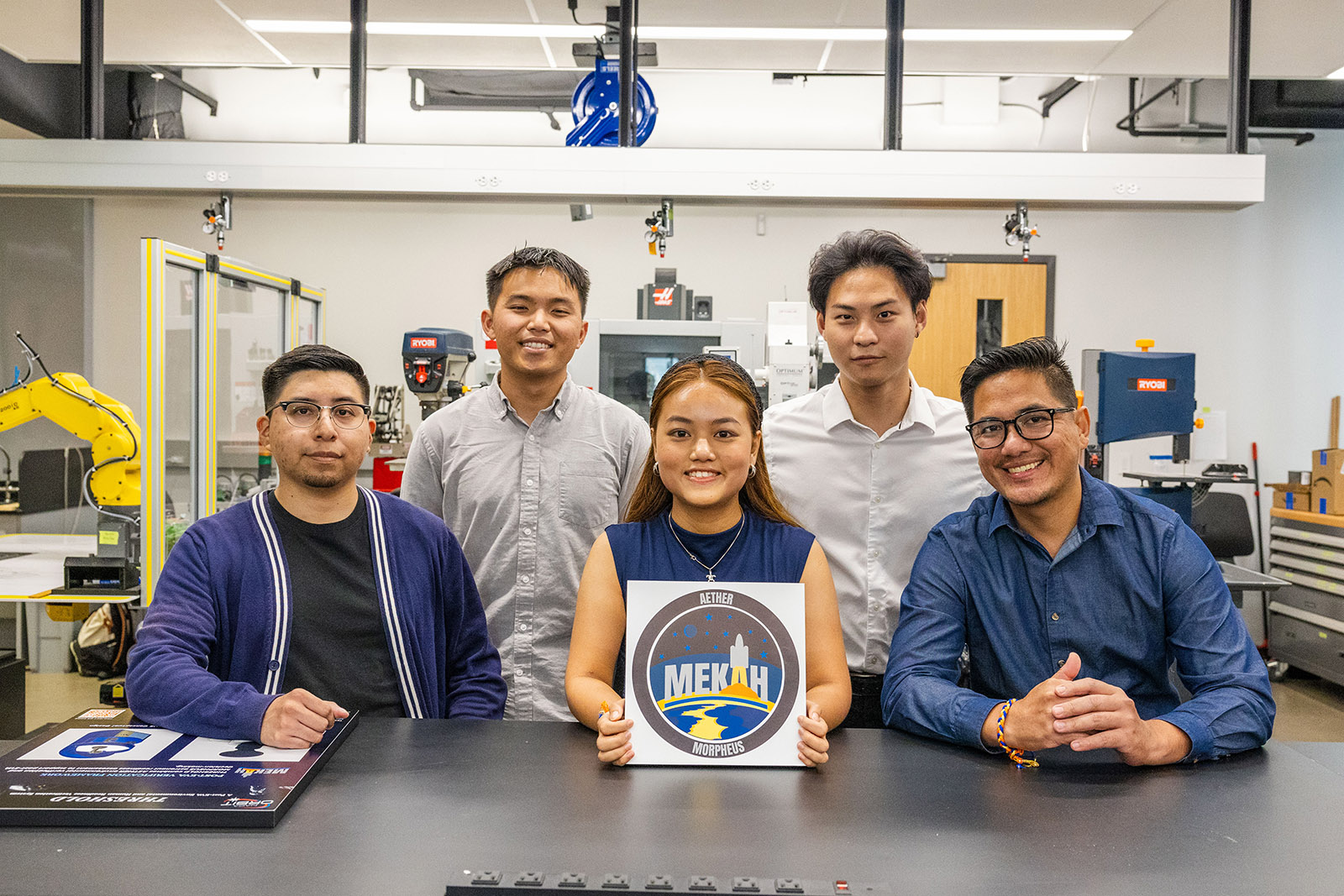
(SANTA ANA, CA) - Four Santa Ana College students who are members of the STEM Core program were named finalists of the NASA ORBIT challenge. NASA Orbit is a competition where university and community college students across the nation develop commercial applications of NASA patents to solve problems on earth or design next-generation technologies for space exploration. SAC students My Le, Arthur Alcocer, Michael Trang, and Tony Mendoza joined UC San Diego student Ken Khant to form Team MEKAH for the NASA ORBIT challenge. As a reward for advancing to the finalist phase, the team received $15,000 in NASA funding to further develop their project and travel to Houston, Texas for the culminating event hosted at the NASA Johnson Space Center.
“The students who worked on this project already stand out as dedicated and engaged students, but with this project they have demonstrated remarkable persistence and resilience,” said professor and faculty advisor Alexander Natale. “MEKAH competed in and lost in a prior NASA event. But they took that feedback, adjusted, and kept at it. It paid off!”
SAC was one of 11 schools selected out of 100 schools across the nation that entered the competition.
“When I found out we got selected, we were surprised and overwhelmed,” said Tony Mendoza.
“We met at school with Professor (Alexander) Natale to watch the announcement on a live stream,” recalled My Le. “When they showed the list of finalists, at first I thought we were out because I didn’t find our name at the top. But when I saw our name in the bottom left corner, I was screaming.”
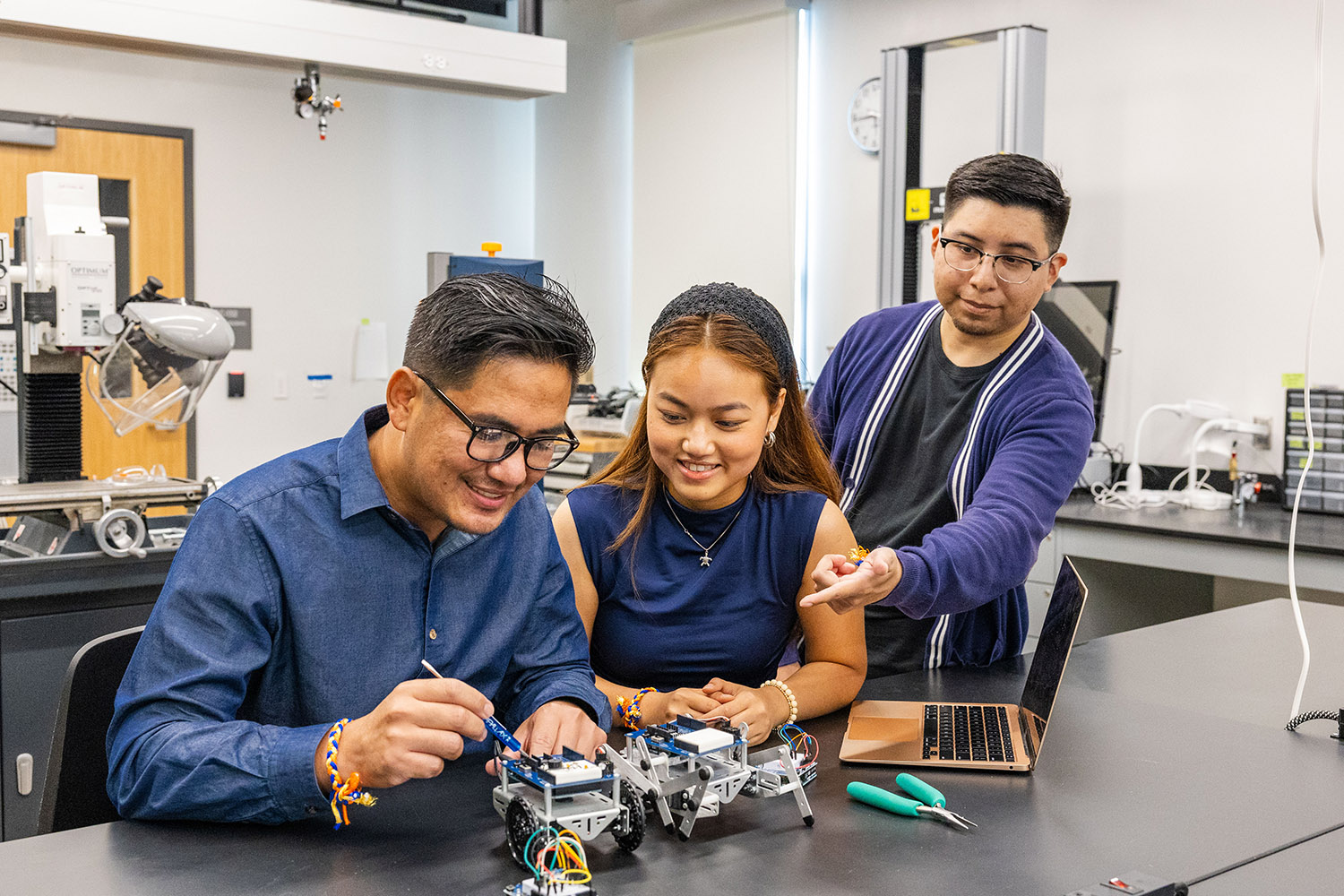
Tony Mendoza, My Le, and Arthur Alcocer work on a robot at the Santa Ana College Science Center
The journey began in early fall of 2025 when My Le, the founder of the team, set her sights on entering the NASA MIND project. While she was developing her idea alongside Ken, she received news in September 2025 that the funding got cut due to the government shutdown. However, the two were determined to not let their project idea go to waste, and it wasn’t until January 2026 when My received an email from a representative at the Kennedy Space Center that a bigger competition was coming up, the NASA ORBIT Challenge. My reached out to the engineering department and STEM Core program at Santa Ana College to find an advisor to help guide her and Ken in the competition and assemble a team. Professor Natale stepped in as the team’s lead faculty advisor and Alicia Ramos assumed the role as the team’s coordinator. Through a network of mutual friends, social media, and the Engineering and Applied Sciences Club, My and Ken recruited Arthur, Michael and Tony to complete Team MEKAH.
Through the Spring of 2026, Team MEKAH collaborated on their submission, Project THRESHOLD, a post-Extra Vehicular Activity (EVA) environmental and human readiness verification system designed to support safer astronaut transitions after EVA operations. The project integrates environmental monitoring and human performance assessment to support safer operational decision-making for future lunar and orbital missions.
Project THRESHOLD consists of two robotic devices: Morpheus and Aether. Morpheus is a robotic device that provides a post-EVA recovery snapshot for astronauts after travelling in space while Aether is a device that performs temperature and environmental readings after re-pressurization from space travel.
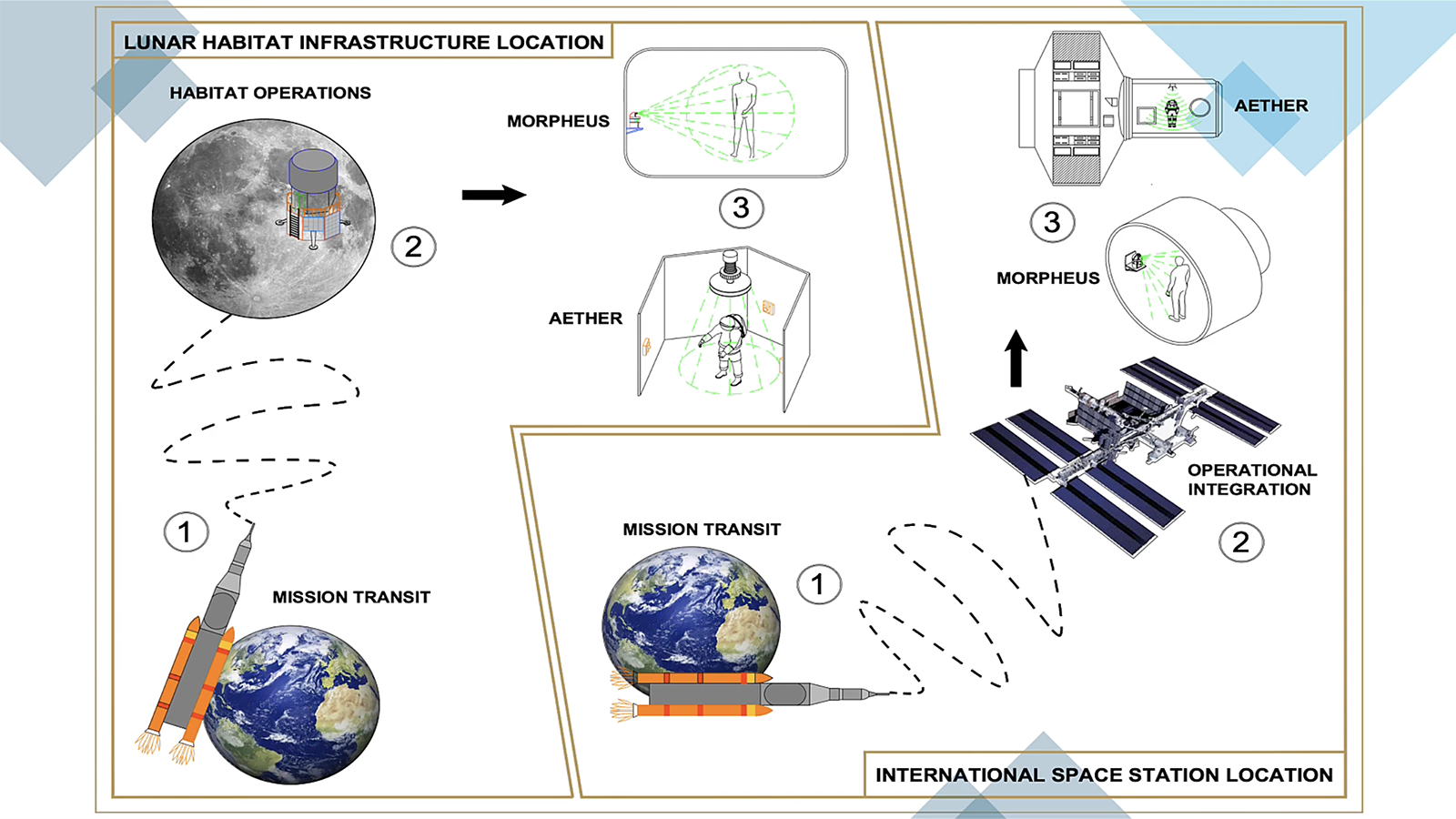
Project Threshold Diagram
“When My and I were designing Morpheus and Aether, I felt like we were working 24/7,” said Anthony. “We would be working until like 11 pm or 1 in the early morning. I would send My Le the drawings on PDF around 4:00 in the morning, and she would still be available on call every single second.”
“I was not going to regret anything,” said My Le. “Sometimes Tony would call while I’m out in LA or someplace and ask questions. I would answer him and share screens to see what he was doing with his CAD model. I told Tony ‘just do whatever you can so that when you look back you won’t feel regret about the project.’”
“I did have concerns with how she responded very quickly,” Tony laughed.
My Le served as a team lead, steering the project forward and maintaining communication with the team advisors and members. Anthony Mendoza is an international student who served as the CAD Design & System Modeling lead. Arthur was the design lead for Morpheus, a medical monitoring device for THRESHOLD, and Michael assumed the role as design lead for Aether, an environmental monitoring device. UCSD student Ken served as the electrical system designer.
“We spent every single day conducting research on and off campus,” said Michael. “Arthur and My Le spent a lot of time asking for a lot of opinions from different experts in the field, including faculty.”
“Talking to Professor Natale helped as far as receiving guidance on the project,” Michael continued. “It’s hard to look through the (competition’s) rules and create something that aligns with those rules, so having faculty who can point you in the right direction definitely helps.”
Team MEKAH logo
“I want to thank all of our advisors, like professor Natale, Professor Timothy Reonisto, Dr. Humberto Gallegos, and mentor Helen Schwartz for being flexible,” said Michael. “They’re so accommodating and that in itself was priceless.”
“We do want to give a shoutout to Alicia Ramos,” said Arthur Alcocer. “She has been a huge help in creating our logo and reserving rooms after school ended. She also improved our essays to be more consise.
The team will be in Houston, Texas from July 14th to 17th for the competition. You can help support Team MEKAH through donations to help bridge the final gap in professional presentation attire and travel essentials. Community support makes opportunities like this possible. Together, we help SAC students turn ambitious ideas into extraordinary achievements and prepare for successful careers in STEM fields.
About NASA ORBIT:
The NASA ORBIT Challenge is made possible through the leadership, expertise, and vision of NASA and its dedicated STEM engagement programs. As a program rooted in authentic NASA missions, technologies, and workforce pathways, ORBIT connects students directly to the people and organizations shaping the future of exploration. Our partners provide the foundational support, strategic guidance, and educational infrastructure that enable students to innovate boldly and take their first steps into NASA’s ecosystem. ORBIT is proud to be delivered as part of NASA’s broader commitment to inspiring, empowering, and preparing the next generation of explorers.
About Santa Ana College:
Santa Ana College (SAC), founded in 1915, serves more than 70,000 students yearly for credit and noncredit classes. At present, SAC students can work toward completing an associate degree, university transfer, career/workforce training or a bachelor's degree in occupational studies. In 2025, the college launched a second bachelor's degree in Paralegal Studies. As part of Santa Ana College, the School of Continuing Education located at Centennial Education Center offers free classes throughout the community for adults of all ages and academic backgrounds. Santa Ana College is an award-winning college and was recently ranked as one of the nation's top two-year colleges awarding associate degrees to Latino and Asian students and named one of the best community colleges in California by Intelligent.com for a 2nd consecutive year. The college is also recognized throughout the state for its comprehensive workforce training programs for nurses, firefighters, law enforcement and medical personnel.